
Key Points
- Equifax is the leading provider of electronic verification of income and employment services in the United States. Public agencies and private institutions rely on this data to assess individuals’ eligibility for credit and government programs.
- Through exclusive agreements with payroll providers and major employers, Equifax controls approximately 40% of U.S. employment records on an exclusive basis. It also uses loyalty-based pricing structures that discourage customers from purchasing from competing providers.
- This structure has enabled Equifax to charge materially higher prices, including to U.S. federal and state agencies.
- Analysis of state contracts indicates that average fees are 51% higher in states where Equifax faces no competition.
- State attorneys general may wish to consider whether these practices warrant legal action to recover overcharges.
- Focusing solely on SNAP and Medicaid programs, estimated damages to states between 2022 and 2025 range from $159 million to $311 million, depending on usage assumptions.
The Work Number Database
Government agencies, lenders and other institutions routinely use verification of income and employment services, commonly referred to as VOIE services, to confirm individuals’ earnings and employment status.
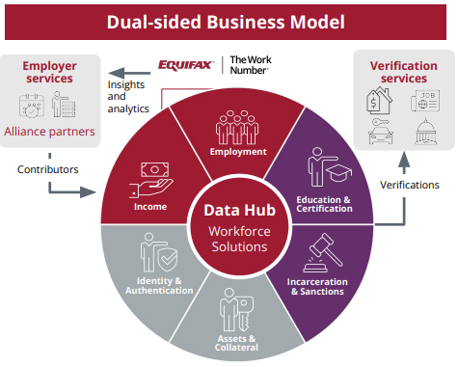
Equifax has led the electronic VOIE market since 2007, when it acquired TALX Corporation and its flagship product, The Work Number, a proprietary database built from payroll and employment records supplied directly by employers. The Work Number aggregates data from employers and payroll processors. According to company disclosures, the database includes approximately 751 million employment records covering roughly 138 million individuals, or about 84% of U.S. nonfarm payroll employment. More than 40% of these records are subject to exclusive arrangements.
Figure 1: Equifax Workforce Solutions’ Dual-Sided Business Model
Source: Equifax Inc.
Equifax derives VOIE revenue from federal and state agencies that administer income-tested programs, including child care, food assistance, housing support, income assistance and student aid.
State agencies, which oversee programs such as SNAP and TANF, contract directly with Equifax for VOIE services. State contracts account for an estimated 70% of total government VOIE spending, projected at roughly $560 million in 2025. Although states are the direct purchasers, federal funding reimburses a portion of these costs. As a result, the federal government represents the largest ultimate contributor to Equifax’s government-related VOIE revenue.
Direct federal VOIE revenue is estimated at approximately $240 million in 2025, with major customers including the Social Security Administration and the Centers for Medicare and Medicaid Services.
Following a class of private purchasers filed in the Eastern District of Pennsylvania, and an investigation by the New York Times, Fideres uncovered evidence showing that Equifax has overcharged U.S. federal and state agencies.
Verification Of Income And Employment Services
Manual verification is not a practical substitute for high-volume users because of time, labor and administrative burdens. Credit reports also fall outside the relevant market, as they measure past credit behavior rather than current income or employment status.
Public data on market shares is limited. However, Equifax has acknowledged in investor communications that it possesses significant pricing leverage derived from its unique data assets.
In correspondence with a state agency in 2022, an Equifax representative stated:
“There is no other provider who offers automated, instant access to these specific employer payroll records; nor is there any other third-party data supplier that hosts a sufficient amount of current, accurate data to meet state agencies’ program needs.”
This characterization is consistent with procurement practices. Many agencies acquire VOIE services through sole-source contracts, reflecting the absence of viable large-scale alternatives.
A Network Of Exclusive Contracts
The alleged exclusionary conduct operates through two principal mechanisms: control of essential data inputs and loyalty-based pricing practices.
First, Equifax entered multi-year exclusive agreements with major payroll processors, including ADP, Paychex and Intuit QuickBooks, as well as large employers such as Walmart and Home Depot. These agreements provide Equifax with exclusive access to payroll data covering millions of workers. Competitors are thereby prevented from assembling comparable databases capable of supporting nationwide VOIE services. In addition, Equifax shares revenue with data contributors, further reinforcing exclusivity.
Second, Equifax employs loyalty-based discounts that function as de facto all-or-nothing agreements. Customers receive discounted pricing if they commit to exclusive or near-exclusive use of The Work Number. Contracts often include annual minimum transaction volumes or minimum spending commitments, raising the cost of partial switching to alternative providers.
These practices limit rivals’ ability to achieve scale. With more than 40% of relevant payroll data foreclosed through exclusivity, competitors face structural barriers to entry and expansion. Unlike Equifax, they cannot fund revenue-sharing arrangements with monopoly rents.
The result, according to this analysis, has been sustained price increases. Company executives have publicly emphasized pricing power in the Workforce Solutions division, citing the uniqueness of the underlying data.
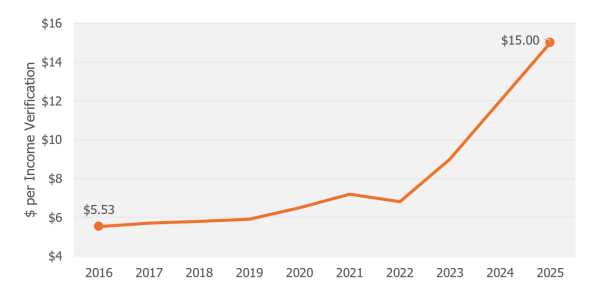
Contracts between Equifax and the Colorado Department of Human Services show that prices rose by more than 170% between 2016 and 2025.
Figure 2: Illustrative Price Increase, Colorado (2016–2025)
 Sources: Colorado Department of Human Services, The New York Times
Overcharge To States
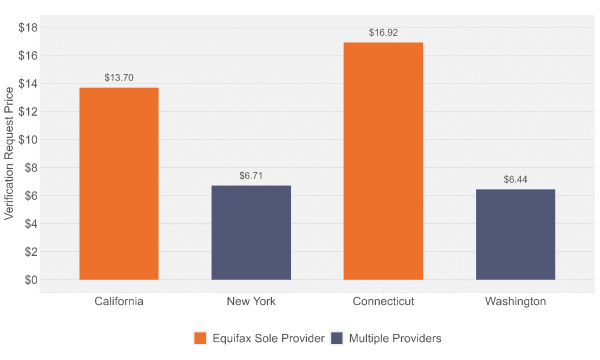
Fideres has reviewed contracts between Equifax and all 50 states, unveiling higher pricing in jurisdictions where the company faces no competition. Washington and New York, where alternative VOIA providers operate, serve as competitive benchmarks.
In 2024, New York paid $6.71 per income verification request. California, a similarly high-volume state in which Equifax was the sole provider, paid $13.70 per request. In lower-volume states, the pattern was similar. Washington paid $6.44 per request, compared with $16.92 in Connecticut, where Equifax was the sole provider.
Figure 4: Comparison of Equifax Rates in States with and without Competition (2024)
Source: Fideres Analysis of State Contracts
To estimate damages, we followed these steps for each state and year:
- Estimate the number of verification requests based on SNAP and Medicaid application data.
- Infer total expenditure based on contract pricing.
- Compare actual prices with a competitive benchmark to calculate the overcharge.
The resulting analysis indicates overcharges of approximately 22% in lower-volume states and 83% in higher-volume states under certain scenarios.
Nationwide damages for SNAP and Medicaid between 2022 and 2025 are estimated under two usage assumptions, namely 50% and 100% Equifax utilization, and two competitive benchmarks.
As mentioned above, states contract directly with Equifax and pay invoices from their own budgets. However, a substantial portion of these costs is reimbursed by the federal government. We therefore present damages with and without accounting for the federal reimbursement.
Under these scenarios, damages to states after accounting for federal reimbursement range from $159 million to $311 million. Without accounting for federal reimbursement, total overcharges would range from $318 million to $621 million over the same period.
Table 1: Damages to States, with/without Federal Reimbursement (2022-2025), $ Millions
| Year | State Damages – With Reimbursement | State Damages - Without Reimbursement | ||
|---|---|---|---|---|
| Equifax used on 50% of accounts | Equifax used on 100% of accounts | Equifax used on 50% of accounts | Equifax used on 100% of accounts | |
| 2022 | $30 | $59 | $61 | $118 |
| 2023 | $43 | $84 | $87 | $169 |
| 2024 | $38 | $76 | $76 | $152 |
| 2025 | $47 | $91 | $94 | $183 |
| Total | $159 | $311 | $318 | $621 |
Source: Fideres Analysis
To find out more about Fideres’s Antitrust Litigation practice, please click here.