
Key Points
- Digital platform markets have repeatedly followed a characteristic trajectory: a competitive entry phase, a period of intense rivalry, consolidation, and the eventual emergence of one or two dominant firms able to earn large rents at the expense of users.
- As AI agents become more integrated into everyday life, a handful of proprietary large language models (LLMs) are growing quickly, backed by capital commitments running into the hundreds of billions of dollars that investors expect to see returns on.
- Despite signs of consolidation, the long-term prospect of a competitive market remains possible, both through competition from open-source models and via competition between closed models. However, this may require pro-active competition enforcement. Fortunately, some competition authorities have been quick to focus on the market, keen to avoid past mistakes, and the newly active role of Attorney Generals across the US may have a potentially pivotal role.
- This note explores where AI competition might be heading, setting out three concerns over how the market might evolve and how the eventual winners will convert dominance into profit:
-
- Concern 1: Enterprise lock-in. LLMs will reproduce platform lock-in through enterprise tooling. Switching costs compound as businesses build workflows, skills, and agents around a single model.
- Concern 2: Vertical foreclosure. Vertical integration across the AI stack, from silicon, to cloud, model, and distribution, will produce potential for self-preferencing and the foreclosure of rivals.
- Concern 3: The agent MFN. As LLM agents begin to direct meaningful consumer spending, model owners will gain leverage over merchants and are likely to impose price-parity, or “most favoured nation” (MFN), clauses.
-
- Each of these concerns maps onto an existing body of antitrust law. The enforcement tools already exist; the open question is if these concerns begin to play out, will the agencies be able to deploy them at the necessary speed to make a difference (and to avoid the mistakes of the past).
A Familiar Pattern of Tech Consolidation?
Almost every dominant technology platform now began, twenty-five years ago or less, as a competitive market with a scramble of entrants, followed by consolidation to one or two players.
Doctorow (2023) identifies the consequences: once a platform achieves dominance, it follows a cycle of progressive degradation he terms “enshittification,” in which the quality of service to users is systematically eroded in favor of extracting value for the platform. Korinek and Vipra (2024) predict that generative AI will follow the same path.1
There are signs of consolidation already visible. On a usage basis, the combined share of the three leading consumer models, namely ChatGPT, Claude, and Gemini, rose from around 85% in 2025 to roughly 91% in 2026 as displayed in Figure 1.
Figure 1: Share of LLM models by usage, May 2025 – May 2026
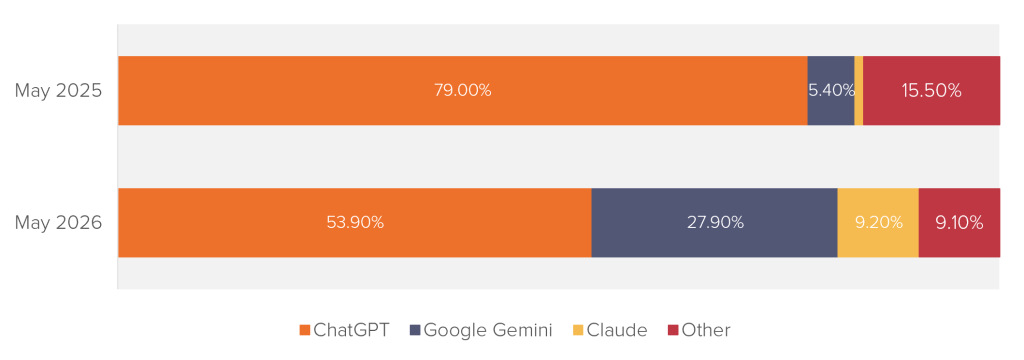
Source: Command Linux2
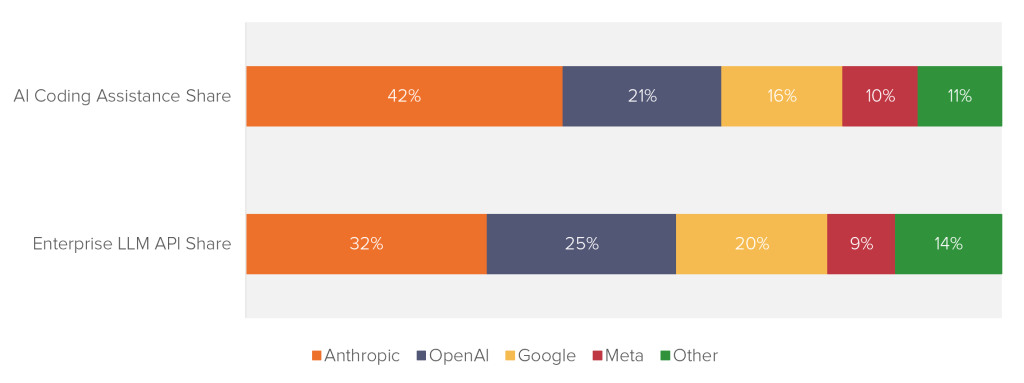
Though LLM usage share varies considerably by specialization. OpenAI retains a high share in consumer-facing applications, but Anthropic has overtaken it in enterprise API usage and is leading in code generation.
Figure 2: Share of LLM Usage by Segment, 2025
Source: Menlo Ventures
In any case, no LLM developer is yet profitable on a standalone basis. Anthropic has reportedly been bracing for losses in the region of $14 billion in 2026, and OpenAI’s losses have run to billions in a single half-year.3 Those losses sit on top of fixed commitments. Amazon alone has agreed to invest up to $33 billion in Anthropic and committed more than $100 billion of AWS capacity over a decade, while striking a comparably sized cloud arrangement with OpenAI.4
Capital deployed on this scale is a bet that today’s losses will buy tomorrow’s rents. Unfortunately, history suggests that if permitted, those rents will quickly cease to reflect differences in quality or efficiency and will instead be built and protected via cheaper anticompetitive conduct that is less vulnerable to the inconvenient uncertainties that come with having to continue to compete for it.
However right now, those bets remain highly uncertain, and there remains the real prospect that more resilient open-source models will thrive, destroying the competitive moat that the leading proprietary closed models are trying to dig (in doing so popping the AI bubble).5
In this context it is encouraging that some competition agencies appear to be aware of these risks. The French Autorité de la Concurrence and, prior to its new ‘business-friendly’ leadership, the UK’s CMA each investigated competition between AI foundation models as early as 2023, while the European Commission, the AGCM and again the CMA have been quick to open cases and seek interim measures.6 This reflects the concern that US monopolists will once again move to create the extractive trade imbalances that the US enjoys across the tech sector. Crucially the more active and innovative private enforcers are hamstrung by the forward-looking nature of the concerns which require attempted monopolization claims, rather than retrospective ones where the harm has already accumulated. As such, public enforcement will be vital, with Attorney Generals across the US having a potentially pivotal role.
We consider below three concerns for enforcers to look out for.
Concern 1: Enterprise Lock-In through Tooling
The first possibility is that competition between LLMs may increasingly be decided not by the models themselves but by the operational infrastructure that accumulates around them, thereby creating scope for anticompetitive lock-in.
The early narrative of the LLM race has been about capability, benchmark scores, and reasoning power. But capability is a fragile moat. Frontier models currently overtake one another every few months, and the lead held by the best model over the next-best is typically narrow and short-lived.7 What is far stickier is everything a business builds around a model once it commits: the workflows wired into core operations, the custom skills and connectors that automate specific tasks, the fine-tuned agents, and the staff who have been trained on a particular ecosystem. Each of these raises the cost of moving to a rival.
This is a dynamic competition enforcement has observed in other markets. It is the reason enterprises rarely abandon entrenched infrastructure software, like SAP’s ERP systems, as investigated by the European Commission.8The software itself is replaceable, but the years of customisation, integration, and workforce training are not.9 Switching means restructuring the business.
The same logic underpins the Department of Justice’s monopolisation case against Apple, filed in March 2024, in which the government alleges that Apple entrenched its smartphone position by engineering switching costs that protect it independently of the merits of its products, a theory a federal court allowed to proceed in June 2025.10
The concern, then, is that the enterprise LLM market will . Once a company’s operations depend on one model’s ecosystem, the integrations, fine-tuning, and internal workflows built around it accumulate, and a competitor has to be not marginally but dramatically better to justify the cost of switching. Because scale feeds the ecosystem (more users bring more integrations and more training data), incumbents pull further ahead.
However, it is also possible that AI tools could weaken the potential for lock-in. If models become good enough at translating between systems, automatically converting workflows, connectors, and fine-tuned configurations from one ecosystem to another, then switching costs fall and the walled-garden breaks down. Open-weight models like Qwen and LLaMA point in the same direction, giving enterprises the option to run capable models on their own infrastructure without committing to a single provider’s ecosystem. Whether these capabilities are strong enough to offset the accumulation of proprietary integrations is an open question, but enforcers would be advised to be vigilant on the creation of frictions and barriers built by closed models.
Concern 2: Vertical Foreclosure
The second concerns leveraging of market power within the supply chain. The AI value chain spans several stages, from compute and silicon, through the model and the tools used to build it, to the products in which it is deployed, as illustrated in Figure 3.
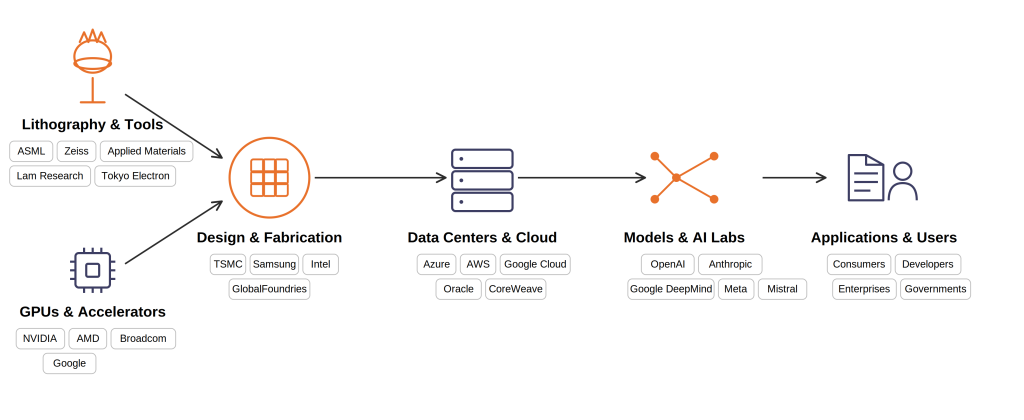
Figure 3: Illustration of the AI Supply Chain
A degree of vertical integration has already taken place, with leading players such as Microsoft, Amazon, and Google present at two or more stages of the supply chain, owning infrastructure like data centers and servers, while also operating across user-facing markets from search to software.11
While vertical integration is not inherently anticompetitive, a firm that is dominant at one layer of the supply chain and present at others has the ability and may in some circumstances also have the incentive to protect that dominance through self-preferencing, tying, or bundling.
For example, while smaller than AWS and Azure, Google is currently the most vertically integrated of the cloud hyperscalers: it owns its TPU silicon, Google Cloud, the Gemini model, and its own distribution channels, and, unlike AWS and Azure, which resell other labs’ models, pays no licensing fees to an outside lab.12 Amazon has built its own Trainium chips, runs AWS, and has committed up to roughly $33 billion to Anthropic (its original $8 billion plus up to $25 billion announced in 2026), alongside a separate $50 billion investment in OpenAI.13 Microsoft pairs Azure with OpenAI while also taking a position in Anthropic as part of a November 2025 deal in which Nvidia committed up to $10 billion and Anthropic agreed to buy $30 billion of Azure compute.14
A number of firms also have an existing user base that might be steered towards adoption of their own models.
- As investigated by the EC, Google has embedded AI Overviews directly into Search and allegedly leveraged its dominance in Search to obtain free access to content for its AI Overviews.15
- Meta, likewise, is alleged to have preferenced Meta AI and its LLaMa models through WhatsApp (AGCM imposed interim measures)16, Instagram, and Facebook. Open and closed source rivals cannot interoperate here without Meta’s permission given it existing grip on messaging and social media.17
- Microsoft offers a subtler example. Copilot has deep, live integration across Windows, Teams, and Office, while rival assistants accessing the same apps through connectors are limited to a largely read-only role.18
- Finally, Perplexity has had to fight attempts by Amazon to block its shopping agent from purchasing from Amazon, thereby restricting its ability to disintermediate online marketplaces (and potentially favouring Amazon’s own shopping agent).
Concern 3: The Agent Layer May Adopt “Most Favoured Nation” Style Clauses
The third concern starts from the observation that the value to a consumer of an AI agent for shopping or booking in downstream markets depends on a basic premise: that using the agent does not make the product more expensive. If routing a purchase through an LLM agent resulted in commissions or referral fees, and was therefore systematically more expensive than going to a merchant’s own site or an e-commerce platform, users may well bypass the agent. The attractiveness of the AI agents in this context only works if it can credibly guarantee price parity for the user.
This demand-side consideration creates a powerful supply-side incentive. To make the guarantee credible, and to enable the recoupment of investment through the charging of commissions to merchants, a dominant model owner has significant incentives to require that merchants not undercut its agent’s price on other platforms, including the merchant’s own website. In practice that might reflect a price-parity clause, or “most favoured nation” (‘MFN’) clause, preventing merchants seeking sales through the agent from offering lower prices elsewhere.
How AI agents might impose or encounter parity clauses in practice is not yet clear. The clause could sit in the agent’s own terms with merchants, in an e-commerce platform’s conditions for surfacing products through its agent, or in some hybrid form where platforms and agents each layer their own restrictions.
What This Means for Enforcement
The common thread across these concerns is the risk that AI agents may obtain or protect market power through anticompetitive conduct, thereby removing the need to compete to improve their products. We consider three familiar moves: raising switching costs, leveraging control of one layer to advantage another, and using contracts that reference rivals’ prices to suppress price competition. The encouraging news is that none of these theories requires new laws or theories of harm and that some competition authorities are already looking closely.
The challenge is one of speed and of scope. Where firms appear to be trying to leverage market power into AI markets through anticompetitive conduct enforcers need to be taking forward-looking cases that focus on the attempt to monopolise or build a dominant position and hence the capability of the conduct to exclude. There is no time to wait for exclusion to occur and harm to emerge and hence there is less scope for active and innovative private enforcement to show the way or pick up the slack (as it has in past tech cases). Agencies need to take cases and obtain interim measures while they do so. In the US, State Attorney Generals need to act while the market is still contestable rather than trying to unwind market power after the fact. The lesson from the platforms that came before suggests they are right to do so.
Sources
1 Korinek, Anton, and Jai Vipra. ‘Concentrating Intelligence: Scaling and Market Structure in Artificial Intelligence’. Working Paper No. 33139. Working Paper Series. National Bureau of Economic Research, November 2024. https://doi.org/10.3386/w33139.
2 ChatGPT vs Gemini vs Claude Usage Market Share: 2026 Statistics and Demographics. 15 July 2026. ChatGPT vs Gemini vs Claude Usage Market Share: 2026 Statistics and Demographics
3 Landymore, Frank. ‘The Amount of Money OpenAI Lost Last Quarter Will Make You Choke on Your Slurpee’. Futurism, 2 November 2025. https://futurism.com/artificial-intelligence/openai-money-lost-quarter; Hwang Chi-gyu. ‘Anthropic Seen Posting $18 Billion Revenue in 2026 with $14 Billion EBITDA Loss’. DigitalToday, 31 March 2026. https://www.digitaltoday.co.kr/en/view/44029/anthropic-seen-posting-18-billion-dollars-revenue-in-2026-with-14-billion-dollars-ebitda-loss.
4 ‘Anthropic and Amazon Expand Collaboration for up to 5 Gigawatts of New Compute’. Accessed 28 July 2026. https://www.anthropic.com/news/anthropic-amazon-compute; Bishop, Todd. ‘Amazon Doubles down on Anthropic with $25B Investment, Mirroring Its OpenAI Cloud Deal’. GeekWire, 20 April 2026. https://www.geekwire.com/2026/amazon-doubles-down-on-anthropic-with-25b-investment-mirroring-its-openai-cloud-deal/.
5 https://www.reuters.com/world/asia-pacific/nvidia-microsoft-other-tech-giants-back-open-source-ai-models-2026-07-24/
6 See https://www.gov.uk/cma-cases/ai-foundation-models-initial-review and https://www.autoritedelaconcurrence.fr/en/press-release/generative-artificial-intelligence-autorite-starts-inquiries-ex-officio-and-launches; ‘AI Tools under the Antitrust Spotlight, as Commission Opens Abuse of Dominance Cases into Both Meta and Google’. Accessed 28 July 2026. https://www.macfarlanes.com/insights/102lya3/ai-tools-under-the-antitrust-spotlight-as-commission-opens-abuse-of-dominance-ca; European Commission – European Commission. ‘Commission Opens Antitrust Investigation into Meta\’s New Policy Regarding AI Providers\’ Access to WhatsApp’. Text. Accessed 28 July 2026. https://ec.europa.eu/commission/presscorner/detail/it/https:\/\/ec.europa.eu\/commission\/presscorner\/detail\/it\/ip_25_2896, https://www.gov.uk/government/news/cma-secures-fairer-deal-for-publishers-and-improves-google-search-services-in-uk, also see https://artificialintelligenceact.eu/
7 ‘Technical Performance | The 2025 AI Index Report | Stanford HAI’. Accessed 28 July 2026. https://hai.stanford.edu/ai-index/2025-ai-index-report/technical-performance.
8 https://ec.europa.eu/commission/presscorner/detail/en/ip_26_1554
9 LegacyForward.Ai. ‘LegacyForward.Ai — Enterprise AI Transformation Framework’. Accessed 28 July 2026. https://www.legacyforward.ai/library/books/the-stack-beneath-the-signal/vendor-lock-in.
10 Kerr Dara. ‘The U.S. Sues Apple, Saying It Abuses Its Power to Monopolize the Smartphone Market’. Business. NPR, 21 March 2024. https://www.npr.org/2024/03/21/1239802162/apple-iphone-doj-monopoly-antitrust-lawsuit; Sokler, Bruce D., and Kristina Van Horn. ‘Judge Allows Justice Department’s iPhone Monopolization Suit to Proceed | Mintz’. 2 July 2025. https://www.mintz.com/insights-center/viewpoints/2025-07-02-judge-allows-justice-departments-iphone-monopolization-suit.
11 GOV.UK. ‘AI Foundation Models: Initial Review’. 16 April 2024. https://www.gov.uk/cma-cases/ai-foundation-models-initial-review. See for example ¶¶1.17-1.19 of the Short Report.
12 Tunguz, Tomasz. ‘The $112 Billion Quarter’. Tomasz Tunguz, 30 April 2026. https://www.tomtunguz.com/2026-04-29-the-112-billion-quarter-hyperscalers-bet-the-farm-on-ai/.
13 ‘Anthropic and Amazon Expand Collaboration for up to 5 Gigawatts of New Compute’. Accessed 28 July 2026. https://www.anthropic.com/news/anthropic-amazon-compute.
14 Blogs, Microsoft Corporate. ‘Microsoft, NVIDIA and Anthropic Announce Strategic Partnerships’. The Official Microsoft Blog, 18 November 2025. https://blogs.microsoft.com/blog/2025/11/18/microsoft-nvidia-and-anthropic-announce-strategic-partnerships/.
15 https://ec.europa.eu/commission/presscorner/detail/nl/ip_25_2964. The CMA also imposed conduct requirements in June 2026: https://www.gov.uk/government/news/cma-secures-fairer-deal-for-publishers-and-improves-google-search-services-in-uk
16 https://en.agcm.it/en/media/press-releases/2025/12/A576
17 Capoot, Ashley. ‘Meta’s New AI Assistant Is Rolling out across WhatsApp, Instagram, Facebook and Messenger’. CNBC, 18 April 2024. https://www.cnbc.com/2024/04/18/meta-ai-assistant-comes-to-whatsapp-instagram-facebook-and-messenger.html.
18 ‘Compare Copilot vs. Claude Enterprise | Microsoft 365 Copilot’. https://www.microsoft.com/en-us/microsoft-365-copilot/copilot-vs-claude-enterprise; Easy365.Io. ‘Claude M365 Connector Now Free — While Microsoft Paywalls Copilot Chat (Basic) in Office Apps’. https://www.easy365.io/claude-m365-connector-goes-free-as-microsoft-removes-copilot-chat-from-office-apps/.